 Meridexion
Salt is the enemy here, not dust. Dust is easy. Salt aerosol gets past media that looks perfectly adequate on paper, and once it is inside the turbocharger or the control air system you are chasing a problem instead of preventing one. There are three filter circuits on a typical engine, and they are specified differently.
In practice, the number on the part is rarely the number we end up quoting.
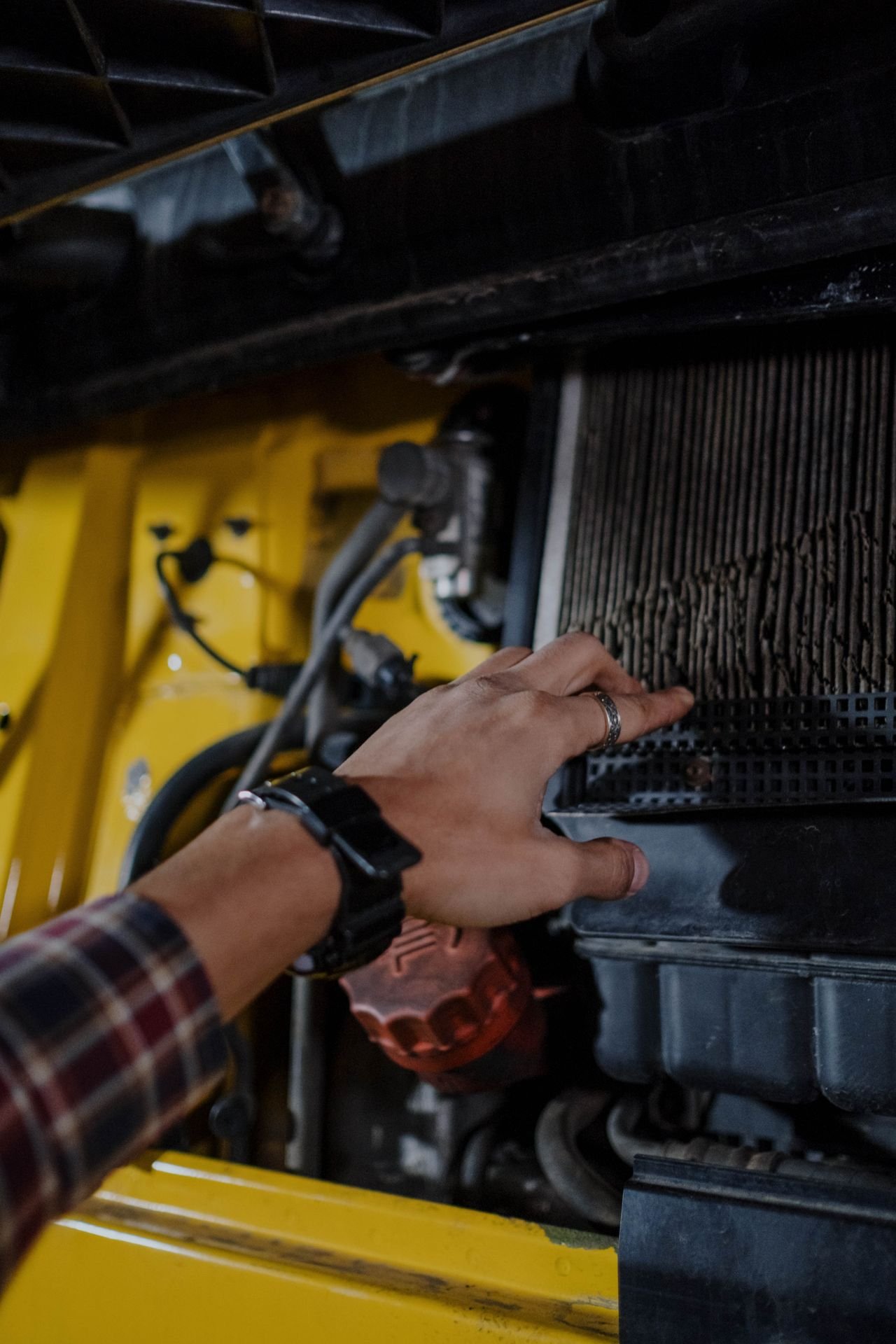
The three air filters on a marine engine
1. Turbocharger and engine intake filters
These sit ahead of the turbocharger compressor and protect the engine from airborne contamination. On two-stroke and four-stroke engines they may be panel filters in the engine room intake, or cylindrical filter elements inside a housing. Salt-laden air is the main enemy: a clogged intake filter raises the pressure drop, reduces scavenge air, and increases fuel consumption and exhaust temperature. Intake filters belong to the turbocharger and air system.
2. Crankcase breather and oil mist filters
Fitted to the crankcase ventilation line, these capture oil mist before it is vented to the engine room. They protect both the environment and the engine room atmosphere, and are increasingly checked during PSC and class inspections.
3. Control and starting air filters
Control air feeds pneumatic instruments, safety shutdown systems and automation. It must be clean and dry — moisture or particles in control air cause valve sticking and false alarms. These filters sit alongside starting air compressors, valves and receivers.
Specifications that determine the correct replacement
Here is the short version:
| Specification | Why it matters | How to supply it |
|---|---|---|
| Outer diameter, inner diameter, length | Determines whether the element seats and seals in the housing | Measure the old element, or send the part number |
| Filtration efficiency and micron rating | Under-specifying lets abrasive particles through; over-specifying raises pressure drop | Original catalogue value, or the engine maker’s requirement |
| Media type | Cellulose, synthetic, stainless mesh or pleated composite behave differently in humid, salt air | Original specification, or describe the operating environment |
| Flow capacity and pressure drop | A filter with insufficient flow area chokes the engine | Engine model and rated air consumption |
| End caps and gasket material | Determines sealing and resistance to oil and heat | Photo of the end caps, or the original part number |
Brands and cross-references
Air filter elements are supplied for the engine makers and for the filtration specialists whose housings are fitted across the industry — MAN Energy Solutions, Wärtsilä, Yanmar, Daihatsu, Mitsubishi, Caterpillar and Cummins engines, and filter references from Donaldson, Mann+Hummel, Fleetguard, Parker, Bosch Rexroth, Mahle, Sakura, Hifi and SF-Filter. A cross-reference is usually possible in both directions: from the engine maker’s part number to the filter manufacturer’s reference, or the reverse.
Where no cross-reference exists, the element can be produced to sample or to drawing, against the original dimensions and media specification.
Replacement intervals and symptoms
- Intake filters — inspected at every port call in dusty or salty conditions; replaced on differential pressure or on the maker’s running-hour interval.
- Symptoms of a blocked intake filter — rising exhaust temperatures, falling scavenge pressure, higher fuel consumption, visible dust on the clean side of the housing.
- Crankcase breather filters — replaced at the scheduled interval, or immediately if oil mist is visible in the engine room.
- Control air filters — replaced on the maker’s interval; any moisture in the control air system is a signal to check the dryer as well as the filter.
For planned maintenance, ordering a full set for the engine rather than a single element keeps the whole system on the same interval — see marine engine parts for the surrounding systems.
What to send when you order
Enquiry checklist for air filters
- Engine make, model and serial number
- Filter position: turbocharger intake, crankcase breather, or control air
- Original part number, or the filter manufacturer’s reference
- Dimensions if the part number is unreadable: outer diameter, inner diameter, length
- Quantity — one element, or a full set for the engine
- Preference: genuine, OEM-equivalent, or alternative
- Destination port and required delivery date
A photograph of the element with its label, next to a tape measure, resolves most identification questions in a single exchange.
Common questions
How often should marine air filters be replaced?
Follow the engine maker’s running-hour interval for scheduled replacement, and use differential pressure across the filter as the practical trigger. In dusty ports, heavy salt spray, or after long coastal passages, inspection intervals should be shortened.
Can I use an equivalent air filter instead of the genuine element?
Yes, provided the dimensions, micron rating, media type and flow capacity match the original specification. Equivalent elements are widely used for routine replacement. Confirm the media specification if the vessel operates in hot, humid or high-salt conditions.
What happens if the intake filter isn’t replaced in time?
A clogged intake filter increases pressure drop, which reduces scavenge and charge air. The engine burns more fuel, exhaust temperatures rise, and turbocharger fouling accelerates. In severe cases the engine can’t reach rated load.
Can you supply a filter if I only have dimensions and no part number?
Yes. Dimensions plus a photograph, and ideally the engine model, are usually enough to identify the correct element or to have it produced to specification.
Get this sourced
Send what you have – part number, drawing, or a photo. We confirm the specification before we quote, not after.